
Best Smartphone Gimbal Stabilizer on AliExpress (2026): 2-Axis vs 3-Axis, and What to Check

A smartphone gimbal is one of the few cheap gadgets that visibly changes what you can make. Handheld video goes from unwatchable wobble to something that looks deliberate, and the hardware doing it — three small brushless motors and an accelerometer — costs very little to build.
Which is why a forty-dollar gimbal and a two-hundred-dollar one are closer than you would expect, and why the differences that matter are not the ones on the front of the box. This page lists what is discounted right now, then explains exactly what to check.
The shortlist right now
Live prices, deepest cut first. The table refreshes automatically.
| # | Product | Price | Was | Off |
|---|---|---|---|---|
| 1 | Broker Handheld Gimbal Mobile Phone Selfie Stick… | $138 | $276 | -50% |
| 2 | Zhiyun Smooth 5 3-Axis Professional Phone Stabilizer… | $210 | $390 | -46% |
| 3 | ZHIYUN Smooth 4 Phone Gimbals Handheld Stabilizers… | $89.00 | $146 | -39% |
| 4 | Baseus 1000A Car Jump Starter Power Bank… | $55.99 | $79.99 | -30% |
| 5 | Snoppa Gimbal Stabilizer Pocket Sized 3 for… | $99.00 | $124 | -20% |
| 6 | Storage Bags For DJI OM 4 Grey… | $7.75 | $9.69 | -20% |
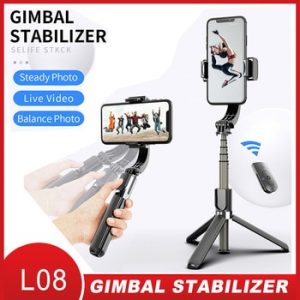
Broker Handheld Gimbal Mobile Phone Selfie Stick For iPhone/Android
The deepest cut on this page: $138 off the seller's list price.

Zhiyun Smooth 5 3-Axis Professional Phone Stabilizer Gimbal for Mobile
The most expensive pick on this page at $210, down from $390.
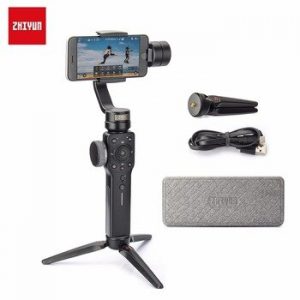
ZHIYUN Smooth 4 Phone Gimbals Handheld Stabilizers for Smartphones
$56.90 off, a 39% cut from the seller's list price.

Baseus 1000A Car Jump Starter Power Bank 12000mAh Portable Battery Station For 3.5L/6L Car Emergency Booster Starting Device
$24.00 off, a 30% cut from the seller's list price.
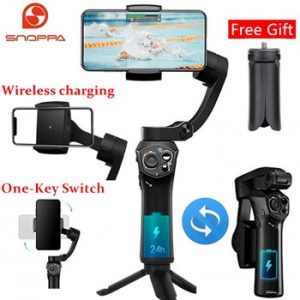
Snoppa Gimbal Stabilizer Pocket Sized 3 for Smartphone
$24.75 off, a 20% cut from the seller's list price.
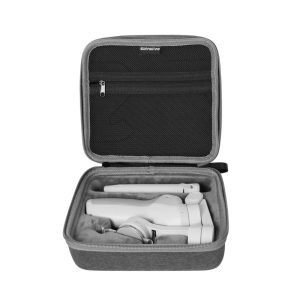
Storage Bags For DJI OM 4 Grey Durable Carrying Case Osmo Mobile 3 Handheld
The cheapest way in here, at $7.75.
Keep reading
Prices are the ones recorded when this page last refreshed and can change at any time. Ali Best is an independent site and is not operated by any marketplace; buying through a link here may earn us a commission at no extra cost to you.
⚠️ 2-axis or 3-axis: the one that decides everything
This is the specification that separates a gimbal that works from one you will stop using, and it is often buried in the description.
- 3-axis corrects pan, tilt and roll. Roll is the one that matters most — it is the sideways tipping of the horizon as you walk. A 3-axis gimbal keeps the horizon level no matter what your wrist does. This is what people mean when they say “gimbal footage”.
- 2-axis leaves roll uncorrected. It smooths some motion, and the horizon still tilts with your hand. For a static shot it is fine; for walking it is barely better than holding the phone carefully.
Buy 3-axis. The price gap at this end of the market is small, and 2-axis is the single most common regret in the category. If a listing does not say which it is, it is 2-axis — sellers with three axes say so in the title.
There is a third thing sold alongside these that is not a gimbal at all: a selfie stick with a phone clamp, sometimes described as a “stabilizer”. No motors, no stabilisation. Check the listing mentions motors or axes before you believe the word.
Payload: will your phone actually fit and balance
Every gimbal has a maximum payload in grams, and this is not marketing — exceed it and the motors cannot hold position, which shows up as a slow drift or a buzzing motor that gives up mid-shot.
- A modern large phone is 200 to 240g. A Pro Max or Ultra is at the top of that range.
- A stated payload of 280g or more gives you headroom. Under 200g is for small phones only.
- Add your case. A thick protective case adds 30 to 60g and widens the phone past some clamps. Many people balance the gimbal with the case on, then find the clamp will not close. Check the clamp width range too, not only the weight.
A related detail that catches people out: if your phone’s camera bump sits at the edge, a narrow clamp can cover the lens. Buyer photos show this; seller renders never do.
Balancing: the step everyone skips
A gimbal must be balanced before you switch it on, with the motors off. You slide the phone in the clamp until it stays level on its own, then power up. Skip this and the motors fight gravity continuously: the battery drains in a fraction of the stated time, the motors get hot, and the footage drifts.
Almost every one-star review that says “the motor is weak” or “the battery died in an hour” is an unbalanced gimbal. It takes thirty seconds and it is the difference between the product working and not.
The app question
The gimbal’s physical buttons — tilt, pan, mode switch — work with any camera app. But the features people buy these for, object tracking, gesture control, time-lapse and panorama, only work inside the maker’s own app.
That matters more than it sounds:
- The maker’s app is usually worse than your phone’s native camera app, and often records at lower quality.
- These apps are Android-first; the iOS version is frequently behind or missing.
- If the maker abandons the app, the tracking feature goes with it. The motors keep working; the smart features do not.
Before buying, search the app name in your phone’s store and read the recent reviews. An app last updated two years ago on a product still being sold is a warning.
The rest of the specification list
- Battery — stated figures of 8 to 12 hours are measured balanced and idle. Real use with tracking is closer to half. Look for USB-C charging and, if you care, a model that can charge your phone from the handle.
- Folding — a folding gimbal goes in a jacket pocket; a rigid one needs a bag. This decides whether you actually carry it, which decides whether you use it.
- Weight of the gimbal itself — 350 to 500g is normal. Heavier is steadier and tiring after twenty minutes.
- Tripod thread — a 1/4-inch thread in the base lets you put it on any tripod. Cheap but not universal, and genuinely useful.
- Fill light — some models build in a small LED. It is weak and it is better than nothing indoors.
Gimbal, or just optical stabilisation?
Modern phones have decent built-in stabilisation, and it is worth being honest about where a gimbal still wins:
A gimbal is worth it if you walk while filming, follow a moving subject, shoot long takes, or want smooth pans and the slow cinematic moves that software cannot invent.
A gimbal is not worth it if you mostly film short static clips, or you film in low light — stabilisation does not fix noise, and at night a cheap tripod does more for your footage than any gimbal.
The things people complain about afterwards
- It drifts or buzzes. Unbalanced, nine times out of ten. Rebalance with the power off.
- It will not pair with my phone. Bluetooth pairing is for the shutter button and the app, and it is separate from the gimbal powering on. Most of these are pairing problems rather than faults.
- Tracking loses the subject. Budget tracking needs good light and a subject that does not turn away. It is a bonus feature at this price, not a reason to buy.
- The clamp will not hold my phone with the case. Measure your phone with the case and compare it to the stated clamp range before ordering.
- The arm blocks the camera. Happens on some designs with large-sensor phones held in one orientation. Buyer photos with a similar phone are the way to check.
Frequently asked questions
Will it work with my iPhone?
The motors and the physical controls, yes, with any phone inside the payload and clamp range. The app features depend on the maker supporting iOS, which is worth checking first.
Do I need the app to use it at all?
No. It powers on, balances and stabilises on its own, and you can film with your normal camera app. The app only adds tracking, gestures and the automated modes.
Is a 3-axis gimbal good enough for professional video?
For social video, travel and interviews, comfortably. The cheap ones differ from expensive ones in build quality, motor strength with heavy phones, and software polish — not in the basic physics.
How long does delivery take?
Two to five weeks on free standard shipping to most countries, three to seven days on paid express from a local warehouse. These contain a battery, so they ship by the slower restricted route.
The short version
Buy 3-axis, never 2-axis. Check the payload in grams against your phone with its case, and check the clamp width too. Balance it before every session with the power off — that one habit prevents most of the complaints in this category. Treat tracking and gesture control as a bonus, and check the maker’s app is still being updated before you count on them.